Testosterone, explained
You lose 1% a year. The lab still calls it normal.
Testosterone falls 1 percent a year after 30. The reference range falls with it, so the bloodwork comes back fine.
One percent is not a number that gets anyone's attention. It is smaller than the gap between two nights of sleep, smaller than the swing between a Monday morning draw and a Friday afternoon one, small enough that no single year ever feels like the year something changed. That is exactly what makes it work. No man loses his testosterone in one bad year. He loses it across thirty good ones.
Maximus states the figure plainly in its own guide. Testosterone peaks in the late teens to early twenties, then declines "roughly 1% per year after age 30." The company then runs the arithmetic forward, which almost nobody does for themselves:
Starting around age 30, testosterone drops about 1% annually. Do the math: by age 50, you're potentially down 20% from your peak. By 70, it could be 40% or more. Maximus, Testosterone Levels By Age
Twenty percent is not a rounding error. It is the difference between a man who trains four times a week because he wants to and a man who trains twice because he ought to. And the reason it goes unnoticed for two decades is not that men are inattentive. It is that the one instrument built to catch it has been quietly calibrated to miss.
The arithmeticDown 40 percent, in range the entire time
The Maximus guide works a single man forward through four decades. He is not a patient with a disease. He is the median case:
Age 25
750 ng/dL
In rangeAge 45
600 ng/dL
In rangeAge 65
450 ng/dL
In rangeWorked example published by Maximus: "a 25-year-old with testosterone at 750 ng/dL might measure 600 ng/dL at 45 and 450 ng/dL at 65." Their conclusion: "he's lost 40% of his testosterone over four decades."
Three blood draws. Three clean results. One man who has surrendered 40 percent of the hormone that governs how much muscle he holds, how well he sleeps, how quickly he recovers and how much he wants anything. In the words of the company's own guide, "He's technically still 'in range' at all three ages."
Nothing on those lab reports was wrong. The reports answered the question they were asked. The question was never the right one.
The instrumentWhy the blood test keeps saying you are fine
Here is the table of reference ranges Maximus publishes, the same kind of table your own lab prints on the back of your results.
| Age | "Normal" | Optimal |
|---|---|---|
| 20 to 29 | 400 to 950 | 600 to 900 |
| 30 to 39 | 350 to 900 | 550 to 850 |
| 40 to 49 | 300 to 850 | 500 to 800 |
| 50 to 59 | 250 to 800 | 450 to 750 |
| 60 and over | 200 to 750 | 400 to 700 |
Read the first column downward. The floor of normal falls from 400 to 200 across those five rows. Now read the chart at the top of this page again. Between his twenties and his fifties the average man gives up about 70 ng/dL. Over the same span the floor beneath him gives up 150. He is sinking. The floor is sinking faster. He is more comfortably "normal" at 50 than he was at 20, holding less testosterone.
Maximus does not hide this. From the same section of that guide:
Notice those ranges are wide. A 45-year-old at 320 ng/dL is technically "normal," but he's at the bottom of the range. [...] Being in range isn't the same as feeling good. Maximus, Testosterone Levels By Age
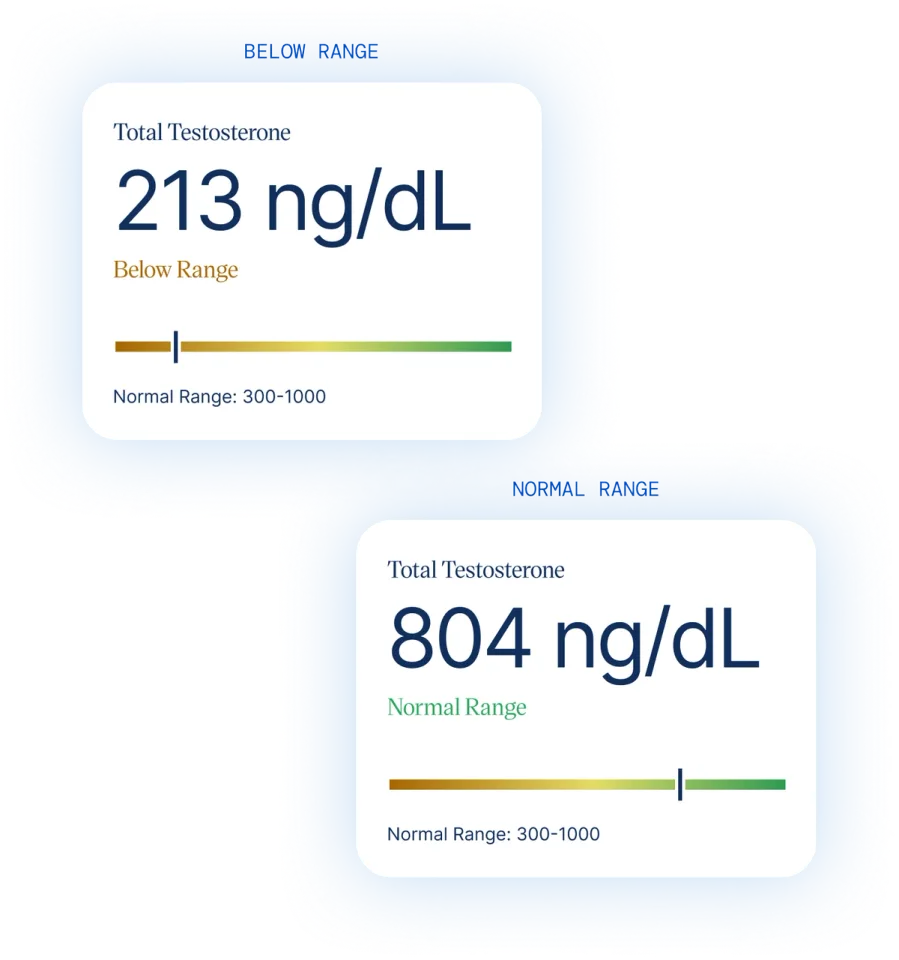
There is a second way the number lies, and it is worth thirty seconds. Total testosterone counts everything in the blood, including the portion bound to proteins and unavailable to you. What your body can actually use is free testosterone, which Maximus says "should typically be above 9 ng/dL." Their guide is direct about the mismatch: "If your total is 600 ng/dL but your free testosterone is only 6 ng/dL, that explains why you don't feel as good as the numbers suggest you should." Most standard panels never measure it.
The number Maximus leads with
1 in 4 men over 30 has sub-optimal testosterone. "If your energy, mood, or drive are slowly slipping, it may be from sub-optimal testosterone levels, even if you test at normal clinical ranges."
Quoted from maximustribe.com/testosterone, where the figure is footnoted to Araujo AB, Esche GR, Kupelian V, et al. "Prevalence of Symptomatic Androgen Deficiency in Men." J Clin Endocrinol Metab, 2007.
What fifteen years of one percent feels like from the inside
Slow losses do not announce themselves as losses. They arrive as opinions you form about yourself. You are not as disciplined as you were. You do not bounce back the way you used to. You have less patience than you would like. Here is the list Maximus publishes, word for word, of what low testosterone actually feels like:
- Tired even after a full night's sleep
- Weight that settles around the middle and will not move
- Sex drive or performance is not what it was
- Foggy thinking, harder to hold focus
- Shorter fuse, flatter mood
- Workouts take longer to recover from
Not one of those items sends a man to a doctor on its own. Together they are simply what people call getting older. The company's own explainer sketches the moment it usually becomes undeniable: "a 47-year-old who used to love playing weekend basketball now dreads it because recovery takes days instead of hours." He has not lost his taste for the game. He has lost the endocrine budget that made the game cheap.

One line from the Maximus review page on Trustpilot says the thing better than any brochure. A member four months into a protocol, describing his starting point in his doctor's language:
Me being low normal at the start was not good, and where I am at now is healthy in all aspects. John Golat, verified review, April 22, 2026, on Trustpilot
Quotation condensed from the published review. "Low normal" is not a diagnosis. That is the entire problem with it.
Before anything elseThe part their own guide tells you to fix first
This is where a page selling a prescription would usually stop being honest. Maximus does not, so neither will this one. Age is only one of the inputs, and it is the one input you cannot negotiate with. The others move, and the company publishes how far they move:
Consistent heavy resistance training
+15 to 20%
Dropping from 30% to 18% body fat
+150 to 200 ng/dL
Sleeping under 6 hours a night, for one week
−10 to 15%
Sustained high stress and cortisol
−20 to 30%
Heavy drinking, chronic
−20% or more
Carrying excess fat, versus a lean man of the same age
−30 to 40%
Every figure above is published by Maximus in its guide to testosterone levels by age, in the sections on lifestyle factors and lifestyle optimization. The guide labels them "try this first."
Add those together and the conclusion writes itself, which is why Maximus writes it: "A 50-year-old who sleeps well, stays lean, manages stress, and exercises regularly can have higher testosterone than an unhealthy 30-year-old." A man who has never seriously tried sleep, strength and body composition has not yet earned the right to be disappointed by his bloodwork.

And for a large share of men, they are not enough. You can do all six and still be a 48-year-old sitting at the bottom of a range that was drawn wide enough to include you. That is the point at which the question stops being lifestyle and starts being medicine.
The catchThe trap hidden inside the obvious fix
The obvious fix is to put the missing hormone back. It works. It also does something most men are never told about until they try to stop. Maximus states it on its own testosterone page, which is an unusual thing for a company that sells the treatment:
Testosterone therapy normally works by replacing what your body makes. Your body reads the higher level, sees testosterone production is not needed, and winds down. It is how the drug works, and it is why coming off is hard. Maximus, maximustribe.com/testosterone
The mechanism is a thermostat, and it is described in detail in the company's own clinical papers. Your brain releases GnRH, which tells the pituitary to release two hormones, LH and FSH. LH instructs the Leydig cells in the testes to produce testosterone. FSH supports sperm production through the Sertoli cells. When the brain detects testosterone arriving from outside, it turns the whole chain down.
This is the trade every man on standard replacement makes, usually without being asked. It is also the specific problem Maximus set out to engineer around, and the reason three of its four routes exist at all. Their advertising states the goal in seven words: published clinical data, no needles, fertility preserved.
The routesFour ways back, and what each one costs
Maximus publishes the comparison itself, including the column most clinics would rather leave out. Dependency means your own production shuts down while you are on it. Fertility markers are the LH and FSH from the diagram above.

Most convenient
Enclomiphene
- Dosing
- 1x daily
- Dependency
- No
- Fertility markers
- Maintained
From $99.99/mo Details

Most natural
Oral testosterone
- Dosing
- 1 to 2x daily
- Dependency
- No
- Fertility markers
- Maintained
From $149.99/mo Details
Most balanced
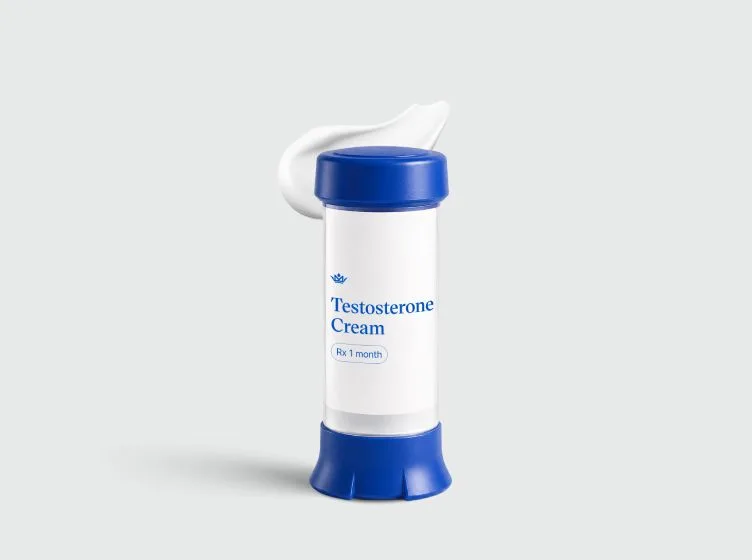
Testosterone cream
- Dosing
- 1x daily
- Dependency
- Yes
- Fertility markers
- Maintained with enclomiphene
From $99.99/mo Details

Most powerful
Injectable testosterone
- Dosing
- 1 to 2x weekly
- Dependency
- Yes
- Fertility markers
- Suppressed on its own
From $99.99/mo Details
Dosing, dependency, fertility and starting prices as published in the comparison table on maximustribe.com/testosterone. Maximus notes that injectable testosterone paired with HCG can maintain testicular size and sperm production, and that the cream maintains fertility markers when taken with enclomiphene at an adjusted dose. Which route applies to you is a prescriber's decision, made on your bloodwork.
The pairings are not a marketing arrangement of existing drugs. Maximus states that the oral and cream combinations with enclomiphene are patented, proprietary Maximus combinations, and it has run the trials to see whether they hold up.
The evidenceWhat happened when they ran the studies themselves
We don't rely solely on external studies. We run our own clinical trials and open-source the data. Maximus, maximustribe.com/testosterone
Four published papers, four different questions, all of them signed and readable in full on their science page. The headline numbers:
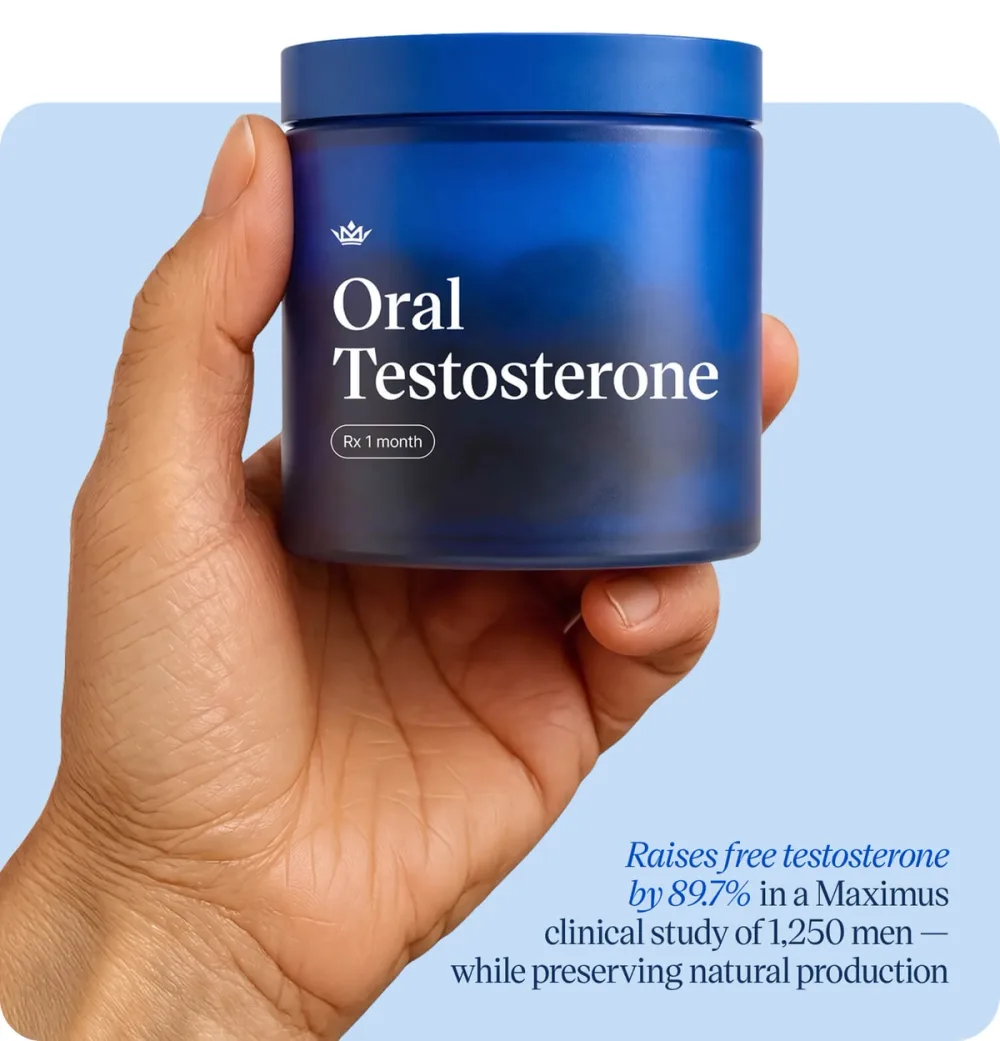
89.7%
Relative increase in free testosterone across 1,250 men on the enclomiphene protocol, with total testosterone up 81.8%.
79.9%
Of those participants reported improved quality of life on the qADAM scale. 67.1% improved on PHQ-4 for depression and anxiety.
4x and 5x
Total and free testosterone in the oral testosterone plus enclomiphene study of 79 men, with LH and FSH staying inside normal range for every participant.
991 ng/dL
Average total testosterone after treatment in a 90-day review of 100 patients on oral native testosterone, an average rise of 505 ng/dL, with no hepatic adverse events.
Sources, in order: the Maximus enclomiphene protocol (1,250 participants), the same paper, oral testosterone and enclomiphene (79 men, both p < 0.025), and liver enzyme trends on oral native testosterone (100 patients over 90 days). Study populations are self-selected clinic patients, not a randomized general population.
The topical paper is the one that answers the fertility question directly. Forty-five men on 100 mg daily topical testosterone were given enclomiphene at three doses. At the lowest dose, 6.25mg, LH and FSH collapsed by 89% and 75%. At 12.5mg and above, every patient held LH and FSH above the fertility thresholds while total testosterone rose 163% and free testosterone 216%. Men who arrived already suppressed from injectable testosterone regained measurable LH and FSH.
None of this makes the treatment right for any particular man. It makes the company falsifiable, which is a rarer quality in this category than any specific result.
The signaturesWho put their name on the protocols
Maximus was founded in 2020 on a single premise, stated on its own about page: "traditional medicine is focused on normalization, not optimization." Everything above is that sentence in practice. The protocols are, in the company's words, "designed by leading doctors and professors including medical school faculty from UCSF, UNC, Tulane, UCLA and Cedars-Sinai."

Dr. Cameron Sepah
Founder. Harvard educated clinical psychologist, former Assistant Clinical Professor of Psychiatry, UCSF

Dr. Matt Coward
Adjunct Associate Professor of Urology, UNC School of Medicine

Dr. Wayne Hellstrom
Professor of Urology, Chief of Andrology, Tulane School of Medicine

Dr. Justin Houman
Assistant Clinical Professor of Urology, Cedars-Sinai

Dr. Eugene Shippen
Hormone expert, author of "The Testosterone Syndrome"

Licensed US pharmacies
Compounding partners vetted by Maximus, prescriptions shipped to your door
Names and titles as published on maximustribe.com/about-us and the Maximus science page.
The next stepHow to find out where you actually stand
Before any of this is a decision, it is a measurement, and most men take the measurement badly. The Maximus guide is specific about how to get a number worth acting on:
- Draw between 7 and 10 AM. Testosterone peaks in the early morning and falls 20 to 30% by afternoon. The same man who reads 340 at 3 PM would likely have read 425 to 450 at eight in the morning, and men have started treatment on that difference.
- Ask for the full panel, not just total. Total testosterone, free testosterone, SHBG, estradiol, LH and FSH. The last two tell you whether the problem is in the testes or in the signal from the brain.
- Ask for LC-MS. Liquid chromatography mass spectrometry is the gold standard. Cheaper immunoassay tests are less accurate, especially at the low end where the decision gets made.
- Retest 4 to 6 weeks later. A single test is a snapshot, and levels can vary by 20% or more between draws. Same lab, same hour.
All four rules are published in the Maximus guide to testosterone levels by age, in the section on when and how to test.

Take the measurement first
You cannot argue with a decline you have never measured, and you cannot fix what a wide reference range keeps hiding. Maximus runs the panel, a board-certified doctor reads it with you, and the protocol only exists if the numbers call for one.
See the testing optionsOr go straight to the four testosterone protocols. Prescription treatment, licensed US pharmacies, no insurance required.
What men on the protocols say
Maximus holds a 4.4 out of 5 on Trustpilot across 1,044 reviews, checked on August 13, 2026. Four of them, published and quotable:
★★★★★
"I spent over 2 years deciding on whether or not to join Maximus, I'm now 2 months in and it has been nothing but a great experience with better than expected results."
Brandon Wright, July 6, 2026. Review titled "Wish I hadn't waited so long."
★★★★★
"At first I wasn't sure if the protocol was making any difference, so I took two months off, and I could really tell the difference. After starting back with Enclomiphene, I have more motivation, have better energy and need less sleep."
Jason McLaughlin, May 21, 2026. Same review, on the fertility question: "my wife and I are in the process of conception. So, having the option to stay on Enclomiphene has been helpful to optimize my performance while remaining fertile."
★★★★★
"I've been training for about 32 years and with age have noticed a decrease in energy level which is now back to a more youthful energy."
Paul, April 12, 2026
★★★★★
"I have been a Maximus Tribe member for two years, and my experience has been excellent. The treatment options are clear, the protocols are easy to understand and follow."
Paulo Mendes, July 26, 2026
All four are published on the Maximus Trustpilot page and belong to their authors. Individual results vary, and the same page carries critical reviews, most of them about billing and fulfillment rather than the medicine.
The pointOne percent, going the other way
The thing about a slow loss is that it is only ever measured against the version of you who is already gone. A man at 48 does not compare himself to himself at 28. He compares himself to last year, where the difference is one percent, and one percent is nothing.
Run the same arithmetic in the other direction. A number that has drifted for eighteen years does not need eighteen years to move back. In the Maximus enclomiphene study, the average participant doubled his free testosterone. In the oral study, total testosterone rose fourfold. The decline was slow because biology is patient. The correction is not obliged to be.
You do not have to accept a range that was drawn wide enough to include the version of you that you do not want to be.
You're losing 1% a year. Take it back.
Bloodwork at home, a board-certified doctor who reads it with you, and four protocols including two that raise your testosterone without shutting your own production down. Free evaluation to start.
See the protocolsPrescription treatment where clinically appropriate. Not everyone is a candidate, and the doctor decides.